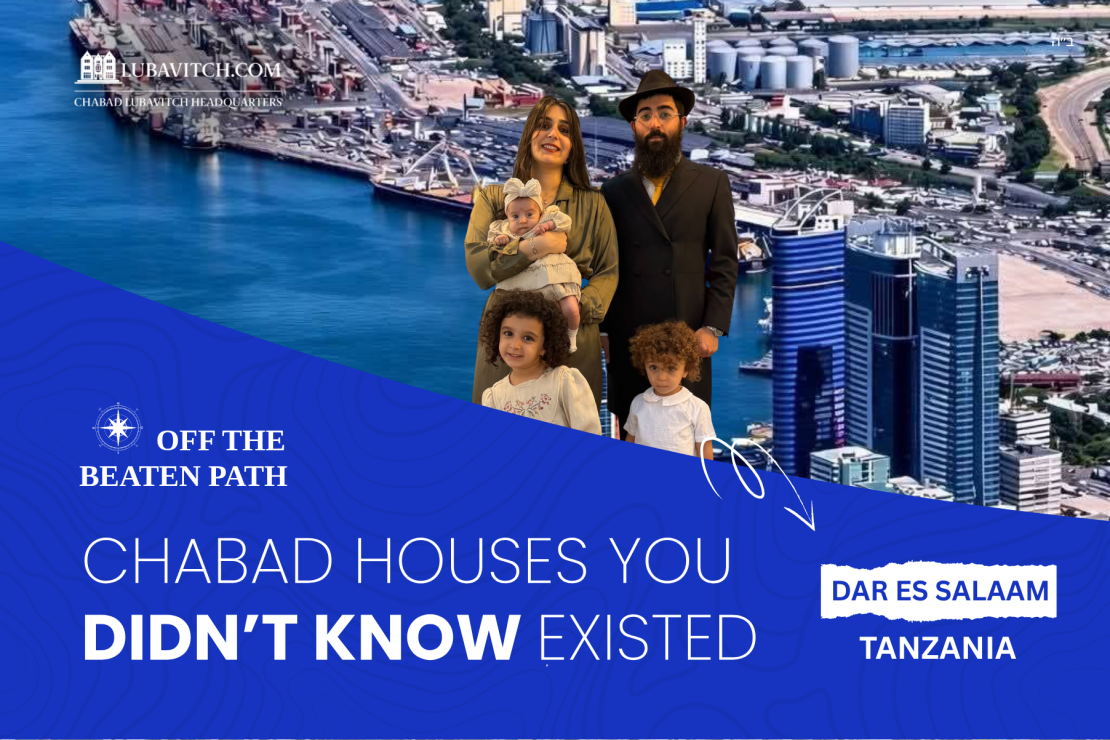


Dar es Salaam means “abode of peace” in Arabic, and it’s where the call to prayer carries over the rumbling of generators. The heat comes off the Indian Ocean and sits. Three-wheeled taxis rattle past a wall topped with wire, down a road that is not really a road but a strip of red dust, and behind that wall lies the only Chabad House in Tanzania.
The power often cuts for an afternoon or a day. The water can get shut off for weeks, and people drink from a tank on the roof that a truck refills at a price that rises with the shortage. Rabbi Shimi Aziza gravely jokes that these cuts tend to happen right before Shabbat or holidays — when they need it most. There is no mikvah in the country; the first one is now under construction. Days before Sukkot this year Rabbi Aziza was still trying to locate the Four Species, calling Chabad in Mumbai for willow branches that they didn’t have either.
The Jews they are there to serve came to Tanzania the way most foreigners do: for work. Dar es Salaam is the country’s commercial capital — embassies, mining, shipping, construction, and the community has formed around that: Israelis, Americans, French, Dutch, Russians, and South Africans. There is also a steady stream of visitors heading for safaris and Zanzibar. When the Azizas arrived there were a handful of Jews — today they count around one hundred.
Rabbi Shimi and Chana Aziza had never heard of the country before they moved there. When he first tried to find it on a map he misspelled the search and landed on Tasmania. Rabbi Shlomo Bentolila, who directs Chabad of Central Africa, called him one day. “I told him, yes, just tell us where you need, and we’re coming.”
Rabbi Bentolila gave them five phone numbers, which was the entire known Jewish community in Tanzania. Three of those families had already left the country. The Azizas started with the two who answered, and a week and a half later they made a Purim celebration for close to thirty people, most of whom had not known each other beforehand. They have been finding the rest the same way since — “one by one.”
Jews have been there before. Yemenite traders settled along the coast in the late 1800s, Moroccans after them, and in the 1930s several thousand Polish Jews fleeing Europe found refuge in Tanganyika — at a moment when the British were seriously weighing the colony as a homeland for Jewish refugees. The synagogue in Arusha was attacked and its Torah burned in the early 1960s, and in the years after independence most of the country’s Jewish families left. By the time two Chabad roving rabbis reached Dar es Salaam decades later in 1999, they organized what was reportedly the first Friday night service there in at least thirty years.
There is no ambulance to call in Dar es Salaam, which Rabbi Aziza found out the week a member of his community went silent after a year of texting him every morning. He guaranteed the hospital bills himself, and when the man passed, spent five days working to get the body released. There is also no Jewish cemetery. They drove four hours out, down a rough dirt road no ordinary car could manage, with more than ten Jews coming along for the burial service.
But for the Azizas, the work in Tanzania isn’t about the extraordinary stories or the obstacles. It’s about the fact that until they came, many Jews there thought that they were the only ones. And now, their work is bringing them together — “echad l’echad,” Rabbi Aziza emphasizes. One by one.
 Related Articles
Be the first to write a comment.