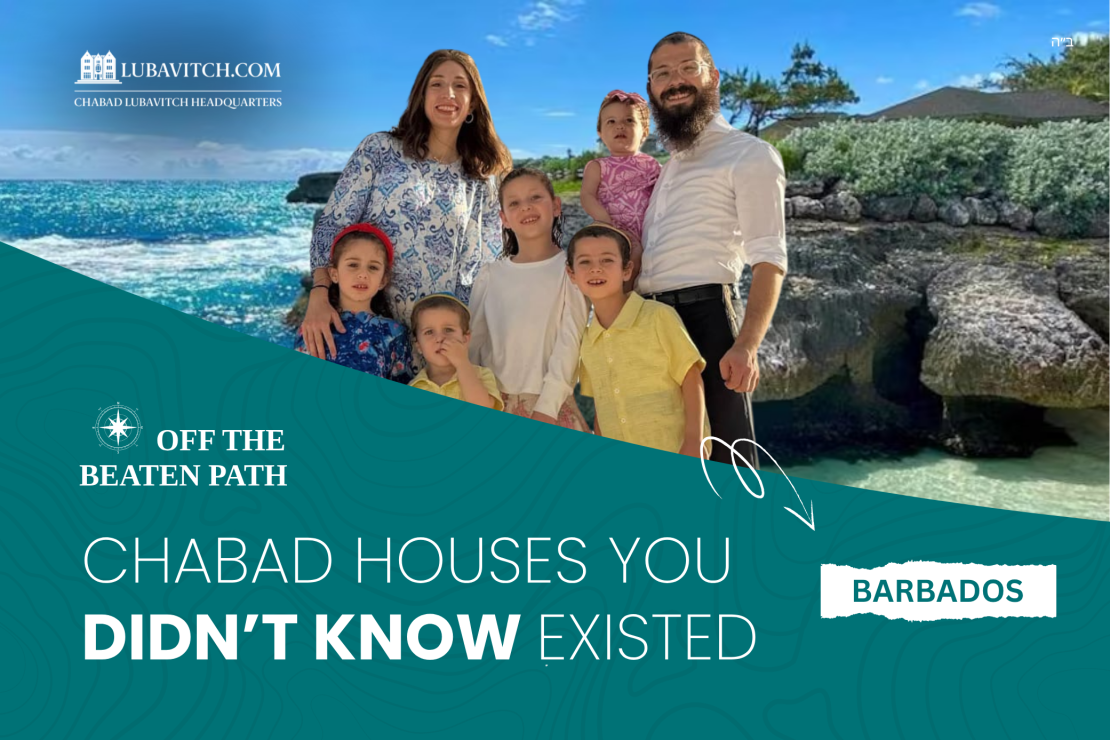


Shabbos comes at nearly the same time every week in Barbados, the furthest southeast island in the Caribbean. Close to the equator, the days barely shift — no long summer evenings, no early winter candle-lighting. Even time moves differently this far out.
There is a street in Bridgetown called Synagogue Lane. Most of the tourists walking past it have no idea why.
The answer goes back nearly four hundred years. Sephardic Jews fleeing the Inquisition in Brazil reached Barbados in the 1620s — barely a year after English settlement — and built the Nidhe Israel Synagogue by 1654, one of the oldest in the Western Hemisphere. They helped transform the island into a sugar powerhouse. The Jewish community peaked at roughly 800 in the 1700s. Then it collapsed — brought down by discriminatory taxes, a catastrophic hurricane in 1831, and economic upheaval after emancipation. By 1928, only two Jews remained. The synagogue was sold to a law firm.
But the thread didn’t break. In the 1930s, Ashkenazi Jews — primarily from Poland — began arriving, planting a new community on the foundations of the old. In the summer of 1959, rabbinical students were sent by the Lubavitcher Rebbe to visit Jewish communities scattered across the Caribbean. The students connected with the Jews in Barbados, and word went back to Brooklyn that a mohel was needed. The Rebbe dispatched one — along with his own personal Torah scroll for the delegation to read from on the island. Eighteen children had a brit. Afterward, the families cabled New York: we have Jewish children now, but we need someone to teach them. So Rabbi Shmuel Pesach Bogomilsky, one of the original students, was sent back to educate them.
That care is what Rabbi Eli and Sterna Chaikin inherited. The Cleveland-born rabbi and his Paris-raised wife moved to the island in 2017 to establish a permanent Chabad presence in Barbados. “Some of those people impacted by those original Chabad visits — they’re good friends of ours,” he said. “When we came, there was a rekindling of that connection. The seeds that were planted there many years ago are still growing.”
Today the Chaikins serve three distinct groups: the several hundred Jewish residents that live on the island, a steady stream of tourists, and a rapidly growing wave of second homeowners and snowbirds who have discovered Barbados over the last several years. Weekends revolve around Shabbat — Friday night dinners and Saturday morning services, and weekdays mean one-on-one meetings, relationship building, and Monday night barbecues that have become a fixture for visiting families. All kosher meat, dairy, and wine must be imported.
The Bajans — as the locals are referred to, are, as Rabbi Chaikin puts it, “very friendly and very respectful. They have a lot of respect for religion.” Many Bajans know little about Judaism, but they’re curious, and the warmth is genuine.
Now, after years of work, the Chaikins are in the final stages of completing a new mikvah — on an island that already holds the oldest mikvah in the Caribbean, the centuries-old ritual bath at the historic Nidhe Israel complex. If all goes as planned, Barbados will soon hold both the oldest and the newest.
 Related Articles
Be the first to write a comment.