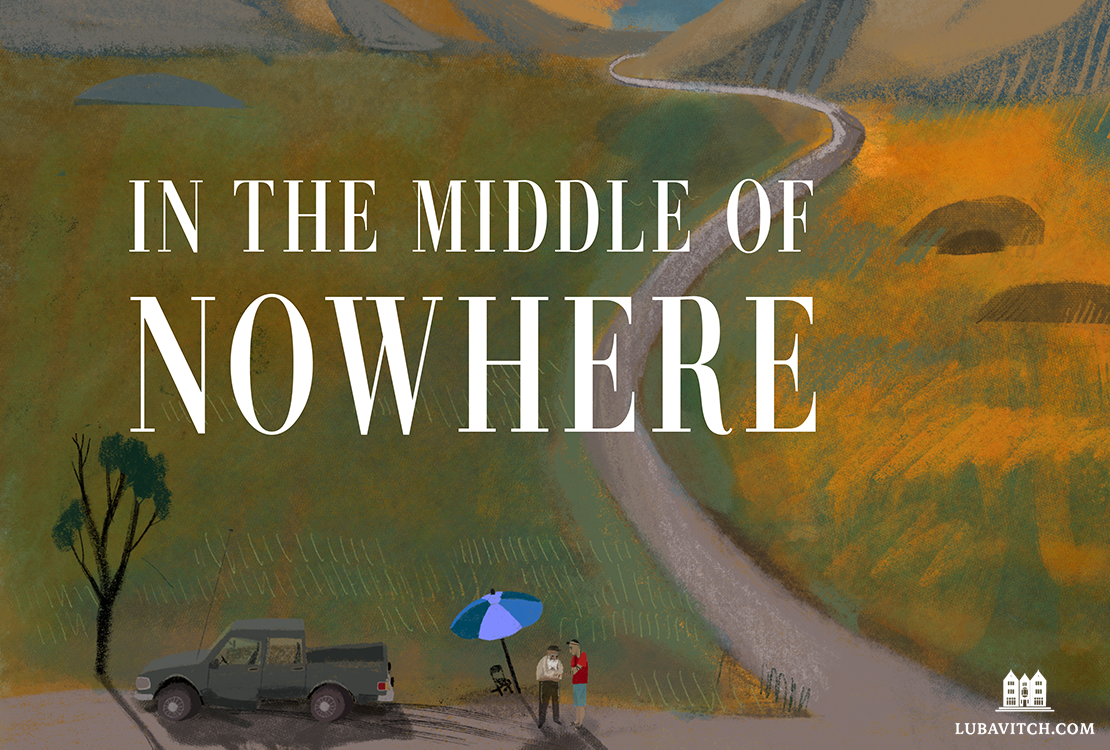


In a tavern on a forsaken road, on a farm in the Soviet Crimea, or in an outpost in the Australian outback: For centuries Jews have lived in remote, rural areas. But is it good for us to be alone? From the Russian innkeeper to the modern Chabad House, the controversial, surprising history of Jewish life in isolation
In the 1960s, the Lubavitcher Rebbe issued a “secret directive” to his Chasidim behind the Iron Curtain. One such Chasid, Hillel Zaltzman, tells the story in his memoir of underground Jewish life in the Soviet Union, Samarkand:
A great number of Chasidic manuscripts, a vast many of which had not yet been printed, were being held in the possession of elderly Chasidim located throughout Russia, and the Rebbe requested that they be smuggled out . . .
Bolshevism had already been regnant for over four decades, pushing its poisonous contempt for religion through the education system and under the jackbooted heels of the secret police. Any Chasidim still caught behind the Iron Curtain led a bleak existence. The vast majority had already been bludgeoned, beaten, and broken, driven into exile or underground, leaving just about anyone else who tried to maintain traditional observance to do so in isolation.
And yet, somehow, a few hardy souls had still stuck around. Acting on the Rebbe’s instructions, an activist in Tashkent manages to locate “dozens of elderly Chasidim dispersed in forsaken corners of the Soviet Union.” He then dispatches a few young men on a series of missions to visit them. One of these young men is the author, Hillel Zaltzman.
Zaltzman’s first trip is to the town of Nikolaev, Ukraine, where he meets an octogenarian Chasid by the name of Itche Schedriner. A lifetime ago, Reb Itche had lived in Lubavitch, Chabad’s spiritual capital, even teaching in its prestigious Tomchei Temimim yeshiva. Since then, however, he has become utterly disconnected from the goings-on of the community.
“Is it true,” the older man asks his young visitor, “that the son has become the next Rebbe?”
By then the Lubavitcher Rebbe had been heading the movement for more than a decade, ever since the passing of the previous Rebbe, Rabbi Yosef Yitzchak Schneersohn, in 1950. But this was not the “son” in question. In fact, the Rabbi Yosef Yitzchak had no sons; he was the father-in-law of the current Rebbe. Instead, the “son” Itche was wondering about was Rabbi Yosef Yitzchak himself, who had succeeded his father, the fifth Rebbe, Rabbi Shalon DovBer, all the way back in 1920.
They tell the story of a Japanese soldier who, after getting lost somewhere in the Philippines, kept on fighting the Second World War into the ’70s. But that wasn’t even three decades; Reb Itche, another man caught behind enemy lines, was more than four decades behind the times.
Later, in a kolkhoz communal farm somewhere in Crimea, Zaltzman finds another lonely Chasid, seventy-eight years old, but with a jet-black beard and the rough, callused hands of a farmer. Originally sent there by Rabbi Shalom DovBer, he sighs deeply when he thinks about the lack of a local Jewish cemetery.
In Homil, there is another Chasid—a shochet who does his secret work under constant threat of informants. This man still walks in the street with a long beard and a long coat, with his tzitzit and kasket cap—rare sights in the Soviet Union. “It was worth the hardships of traveling by train and plane, just to see this,” writes Zaltzman. “It was a marvelous sight to behold.”
Zaltzman’s travelogues struck a chord, and stayed with me for a while. They are poignant scenes of overwhelming tragedy, of people who have the rug pulled out from under them so violently that they cannot hope to ever regain balance. With their connection to the past frayed to memories, any dreams of continuity are left tattered beyond repair. And along with this deep pathos there is also something awe-inspiring in the resilience of these men who, caught out of time and place, still manage to cling heroically to a few threads—to remain Chasidim.
But those snapshots from life on the Soviet spiritual wasteland also belong to a broader narrative genre. They are Hebraic takes on adventure tales set in faraway lands. These are tales of space explorers venturing beyond the final frontier—of Jews finding themselves in strange and surprising places. A fish out of water, but kosher.
Examples of stories in this genre abound, from true stories to fiction to somewhere in between. Benjamin of Tudela’s medieval travel diary describes the lost tribes of Israel living as an independent polity in the “mountains of Nishapur,” allied with a fierce nomadic tribe who “worship the wind,” eat only raw meat, and (bizarrely) “have no noses.” And in the 16th century, the mysterious David HaReuveni caught the imagination of the kings of Europe, telling tales of lost tribes and Jewish warriors, out somewhere in the distant East.
With the move to the New World, the advent of the modern age, and the introduction of new storytelling forms, we have grown only more fascinated with Jews in strange places: In the 1910 Jewish Gauchos of the Pampas, for example, author Alberto Gerchunoff shares a collection of tales based on a real-life settlement program that sent thousands of Russian Jews to farm alfalfa or raise cattle on the plains of the Argentine hinterland. At the other end of the Americas, and nearly a century later, the television series Northern Exposure tells the story of Jewish neurotic New York doctor who has to hang out his shingle in small-town Alaska. And then, of course, there is Gene Wilder’s endearing turn as a wide-eyed yeshiva student roaming the American West in The Frisco Kid—arguably the most sympathetic depiction of an Orthodox Jew in all of American cinema. The list goes on and on.
The popularity of these “Jew-out-of-water” narratives has endured for a reason. In part, they’re entertaining, for the way that they surprise and subvert expectations. But my sense is that, below this surface, lie deep theological waters.
It Takes a Shtetl?
The tacit assumption beneath all of these premises—and the reason they seem to offer such a rich narrative vein—is that Jews belong someplace else.
Seen through the long lens of history, zoomed out far enough, there is an undeniable truth to this. Since the days of Abraham, the Hebrews have had a homeland. It was only under duress that Abraham himself had to leave the Land of Canaan; his grandson Jacob lived a “stranger” in his uncle Lavan’s town; the Israelite experience in Egypt was nothing more than a 210-year “sojourn”; exile is always an aberration. And even as our current stint in the diaspora stretches onto nearly two millennia, the conviction that exile is an unnatural state persists.
But let’s set down the lens of history for a moment, to consider some more immediate, practical concerns. There is another set of reasons those stereotypes about where Jews “belong” strike a chord. Put simply, Judaism needs numbers. This is most clearly true at the synagogue. Without the presence of ten men, there are some prayers that simply cannot be recited. Ideally, you need a quorum to get married, to revoke a vow, and to bury the dead. And there are so many other ways in which normative Jewish life is almost impossible without a community—to build the synagogue in the first place, to run the school, to generate the demand and supply of kosher food, to host guests at the Shabbat table. So teaches the Talmud (Sanhedrin 17b):
It has been taught, “A scholar should not reside in a city where the following ten things are not found: a court of justice; a charity fund; a synagogue; a public bath; a public bathroom; a circumciser; a surgeon; a notary; a slaughterer; and a schoolmaster.”
Living in a town too small to sustain the basic components of Jewish communal life, the Talmud suggests, is untenable. At the very least, it is unideal. If being outside the Land of Israel means being in exile, then pitching up anywhere beyond the outer limits of a Jewish population center—beyond driving distance from a Jewish school or walking distance from a shul—is an exile within an exile. “If you were to give me all the silver, gold, precious stones, and pearls in the world,” the sage Rabbi Yossi once declared to a fellow he met out in the sticks, “I would not dwell anywhere but in a place of Torah.”
But is it really such a crime to take your chances outside of South Florida and the New York Tri-state area? If you’ve ever heard a Chasidic story involving an innkeeper, perhaps a poritz, or maybe a wagon, you’ll know that things aren’t quite as simple as that.
That’s because for centuries, living in remote or rural areas was precisely what countless Jews did for a living. Wealthy landowning squires would rent out parts of their sprawling estates—from mills to forests—to Jewish leaseholders, who could ply their trades so long as they paid their dues and kept their mostly gentile clientele happy. Notably, these leases often had something to do with spirits: running distilleries, breweries, taverns, and plenty of inns. Around the turn of the 19th century, it’s estimated that a full third of Eastern European Jewry was in some way connected to the production or sale of alcohol.
And where are all those inns and innkeepers? A good many of them are on the road, of course, and away from the major cities. Ditto for other elements of the leaseholding system. So even though most Jews lived in cities and towns, there were tens of thousands living in smaller villages and hamlets, and often in even greater isolation.
“Life in the village,” writes the Chabad Chasidic scholar Rabbi Amram Blau, “was not so simple”:
In most villages, a few isolated Jewish families lived in an otherwise entirely non-Jewish village, without a minyan, and without proper education for their children. They maintained daily contact with rough, hard-pressed peasants being squeezed by their squires, and whose only refuge was the Jewish tavern, where they could drown their sorrows in the bitter drop. Since [selling alcohol] was the Jews’ primary livelihood, at times, this was connected with the desecration of Shabbat.
Shabbat desecration may have been the aspect of tavern trade that attracted the harshest censure from seventeenth-century rabbis, but there were other concerns which, to some, rendered the entire notion of Jewish rural life unacceptable. There was the lack of regular communal services, the difficulty of accessing Jewish education, and the spiritual degradation that came from catering to the coarsest Polish and Ukrainian peasants.
This critique – and two sides of an intriguing debate – would sharpen into focus when developments in the late eighteenth century placed an ominous question mark over Jewish rural life.
Partition, Expulsion, Settlement
Perhaps predictably, Eastern European Jews’ association with alcohol—forced on them by lack of alternative—was soon turned against them. In the late eighteenth century the Russian nobility, complaining of the Jews’ deleterious influence on pure-hearted peasants, demanded that Jews be removed from the villages. In 1782 the governor of Mohilev banned the local gentry from leasing any inns, taverns, or breweries to Jews, and crammed the suddenly dispossessed Jews, numbering in the thousands, into larger regional towns. In 1804 this campaign went national, with Tsar Alexander I’s statute “Concerning the Organization of Jews.”
According to some historians, some sixty thousand Jews would be impacted by this new piece of legislation, which, in addition to punishing landlords and Jews who dared to defy it, also declared that “all debts that peasants and other people owe in taverns, etc. kept by Jews, are void without compensation.”
The results of these statutes were catastrophic: In White Russia, anguished streams of Jews were driven out of their homes by merciless gendarmes, often plundered of their possessions, and left with no means of supporting themselves. Starved, thirsty, exhausted, and exposed to the elements, these Jews headed towards whichever communities would have them. And already crowded Jewish towns strained to house these desperate refugees.
“I could not bear the pain and the suffering,” Rabbi Schneur Zalman of Liadi, the first rebbe of Chabad, writes in a letter describing his communal activities during this period, “of those villagers… cast into the streets, swollen from hunger, and dying from starvation.”
At the same time, a small sliver of hope emerged for these poor Jews, or at least for some of them. For all of the cruelty of the 1804 laws, they at least attempted, on paper, to offer Russia’s rural Jews some alternatives: The same laws also recognized a right of Jewish farmers “as well as manufacturers, artisans, merchants and burghers” to buy, sell, or rent “unpopulated land.” Not only that, but those who could not afford to buy or rent could apply for crown land to settle.
Much of this land was in the steppes bordering the Black Sea, a region known as New Russia, which had been annexed to the empire under Catherine the Great. Now the crown was eager to develop this sparsely populated land, even if that meant letting Jews own some of it.
Not that any of this came easily: The climate was unfamiliar, the land was ill-suited for small-scale farming, and the colonists—who knew much more about tending bars than tending fields—were desperately short on equipment, experience, and government aid. Many settlers were injured, died, or gave up for the next-worst option back home. Generally it was the poorest, most desperate families—the ones with no safety net to fall back on—who stayed.
Still, beginning in the year 1806, a series of Jewish settlements, or kolonyes, were founded there, and by 1810 over 1,500 families had settled in the area. By the end of the century there were some 60,000 Jews living in 170 kolonyes, and more than 100,000 Jewish agriculturists working their own land overall.
Throughout this time the spiritual leaders of the day, prominent among them Rabbi Schneur Zalman, worked energetically to support the dispossessed rural Jews. Through fundraising trips and community taxes, they financed efforts to cancel the law or at least to alleviate the plight of the refugees. They helped the aspiring agriculturists settle down, while lending important moral and religious support to the incipient kolonyes.
Rabbi Schneur Zalman’s grandson would eventually establish a Chasidic kolonye, which would become a haven to hundreds of families—including the previously mentioned Itche Schedriner, whom Hillel Zaltzman would encounter so many years later.
Ultimately, the efforts on behalf of the refugees saw some remarkable communal cooperation between the Chasidim and their Lithuanian opponents (the mitnagdim) who had been sworn enemies just a few years before. But not everyone was on board to support village Jews.
Two Views of the Country Life
Following that early expulsion from Mohilev, Chasidim of the region wrote to Rabbi Menachem Mendel of Horodok, a predecessor of Rabbi Schneur Zalman, to tell him of the hardship caused by the decree. By then living in the Land of Israel—he had led the first “Chasidic Aliyah” there in 1777—the Horodoker sends back a few words of comfort, while mentioning that the government’s move against its Jewish subjects was foreseeable, and may even be for the best. Therefore he suggests:
My opinion and advice is that, even if the royal decree is rescinded, and they have permission to work in this source of livelihood, they should distance themselves as much as possible…
Others were even more forthright with their reservations. Rabbi Baruch of Mezhibuzh, the grandson of the Baal Shem Tov, expressed his skepticism about the value of Rabbi Schneur Zalman’s fundraising efforts on behalf of the refugees in surprisingly stark terms. And although the saintly Rabbi Yisrael of Ruzhin supported efforts to avert or mitigate the refugee crisis, he balked at the thought of encouraging those Jews to move to the “desolate lands” of New Russia and work the soil there.
When seen from purely humanitarian grounds, this opposition is hard to fathom. “Could anyone think that such a sainted figure as Rabbi Boruch did not care that his fellow Jews were dying from famine?” wonders the scholar Blau, before answering his own question. As he explains it, these Chasidic figures saw the government’s antisemitic edicts as a reflection of a Heavenly opposition to the rural settlements. Jewish people were being sent out of these places, in other words, because they were not supposed to be living there.
“This matter is from G-d,” Rabbi Menachem Mendel of Rimanov was said to have declared, “and He put it in the heart of the Crown to banish you from the villages… [where] you have been spending your days in vanity…not praying with the community, and profaning the Shabbat. Therefore, the only answer is to live in the towns, among other Jewish people, to pray with a quorum, and observe the Shabbat.”
And, despite these sincere concerns, Rabbi Schneur Zalman and his allies took a different approach. Why?
Partly, perhaps predominantly, their response was driven more by empathy than by principle. The suffering of the exiled refugees was immense and it was immediate: However problematic country life may have been, what these Jews needed was a home, a hearth, and something to hope for, not a lecture on Shabbat observance.
Yet along with this, we also find attempts to engage with the innkeepers’ critics—to defend their way of life on religious grounds.
One account of Rabbi Schneur Zalman’s thinking comes to us in an extraordinary story revealed years later by his great-grandson. While Rabbi Schneur Zalman was working to stave off the expulsion edicts, he took a trip by carriage, fell asleep, and had a dream. When he awoke, he recounted to his traveling companion what he had learned: The edicts were the result of a heavenly charge against the villagers, on account of their desecration of Shabbat.
If so, then we should go back, his companion reasoned.
“I do not think so,” replied Rabbi Schneur Zalman. “The villagers provide food to travelers. If someone comes from the city to do business in the village, he finds a place to pray, and he finds a tallit and tefillin… they need to be in the villages.” The problem of Shabbat observance, he added, was something that could be fixed.
“Jewish materiality,” he once aphorized, “is spiritual.” And so it was in this case: To him, concern for the physical welfare of the Jews did not have to be in tension with spiritual flourishing—neither for the innkeepers nor for their guests.
The Rebbe’s Innkeepers
A Jewish oasis, far away from established communities, a place to get a bite of kosher food, to join a Shabbat meal, to put on tefillin—is any of this ringing a bell?
Since the days of taverns and roadside inns, the idea of the geographically isolated Jewish outpost has had a thousand echoes; not only in the classic Chabad House model, but also in more personal ways. In fact the story of how my own family arrived in Australia in the 1940s mirrors this broader idea in so many ways, sometimes inverting it entirely.
In 1947 my grandmother arrived at the docks in Melbourne with her parents, Rabbi Zalman and Brocho Serebryanski. But instead of moving to the large local Jewish community, these Russian immigrants spent their first few years some two hundred kilometers away from the big city. There, in the fertile Golbourn Valley, outside of a little farming town called Shepparton, was an unlikely Jewish settlement led by a man who ran a successful orchard and fruit case–making business. His name was Reb Moshe Zalman Feiglin, and for quite a few years he had been the only Chabad Chasid on the entire continent.
My great-grandparents fled from Russia for sheer survival, but with the letter of blessing and encouragement they received from the Previous Rebbe, they understood that there was more to their move than that.
Rabbi Yosef Yitzchak wrote of “strengthening Judaism” and making “Australia a place of Torah.” He advised Reb Zalman to collect and bring along Torah books and other literature, and even encouraged him to use the opportunity of his upcoming sea voyage to speak with the other passengers about the service of G-d. “When you ensure that the ways of spiritual service are illuminated for someone else,” wrote Rabbi Yosef Yitzchak, “the reward is that one’s own matter and spirit are illuminated from Above.” My zeide’s search for a safe haven had been sublimated into a life’s purpose, an illumination of both matter and spirit.
As with the innkeepers in the days of Rabbi Schneur Zalman, physical needs did not have to come at the expense of spiritual opportunities; the two were dovetailed and intertwined. But where the first Chabad rebbe had supported the innkeepers in spite of their spiritual isolation, in the days of Rabbi Yosef Yitzchak and his successor the Rebbe, this idea was turned on its head: Young families were sent to far-off places precisely because there was no established Jewish community—and in order to create one.
The revolution here was so thorough that it’s almost hard to imagine what the fuss was ever about; what was once an ex post facto defense had become reinvented as an ex ante ideal; a defensive strategy had been transformed into an offensive maneuver. The institution of the shliach, or emissary, was born.
Oh The Places You’ll Go
My great-grandparents stayed in Shepparton for only a few hardscrabble years, running that tiny yeshiva in a quiet farming town. But sending Chabad emissaries to Australia wasn’t the beginning of the story, and it certainly wasn’t close to the end. From the earlier days of his leadership, the Lubavitcher Rebbe dramatically expanded the field of shlichut. It’s history that has been told a hundred times, commemorated and celebrated, and rightly so: Today those shluchim dot every corner of the globe, from Anchorage to Zanzibar.
And it always is Anchorage and Zanzibar, or somewhere equally exotic.
The Chabad movement has invested immense resources specifically in reaching out to Jews in remote areas or places, without any Jewish infrastructure. Today it’s a Pesach Seder in the Himalayas, tomorrow lighting a Menorah on the North Pole, and Tashlich in the Mariana Trench the day after.
You might say that Chabad Houses are like an updated model of those Jewish inns that were once sprinkled across the Russian countryside, offering a spot for Jewish travellers to pop in while on the road, to put on tefillin, and pray in a shul.
But if Chabad emissaries are simply trying to encourage as many Jews to do as many mitzvot as possible, then the logic of Chabad Houses isn’t quite clear. In purely pragmatic terms, aren’t cities the best places to meet the most Jews? Why go all the way to Zanzibar to find a door missing a mezuzah?
The Rebbe once addressed this very question at a public gathering on Purim, 1968.
“The effort that must be invested in order to reach a single Jew in some farflung place…when applied to one’s own vicinity, can have an impact on a greater number of Jewish people,” he observed. “Why then focus on one Jew, one family, or a few families?”
To this the Rebbe offered a couple of responses: Firstly, and especially in our times, he explained that one must make a positive impact wherever opportunities present themselves. As the Talmud says, “If a mitzvah comes your way, do not miss it.” And so, if you hear about a single Jew who needs help in one single area, then you ought to get involved, even if it seems spiritually inefficient. After all, it is G-d who placed this opportunity before you, and He’s the one who knows how to make those kinds of calculations.
Furthermore, the Rebbe said, when the Jew who needs help is someone whom “no one else knows about but you—if you don’t help, then who will?” The fact that there are fewer people and resources in those remote communities is a reason to go, not to stay away. And sometimes, by having a positive influence on others, who then go on to influence others, a single person can uplift an entire city or country. By playing such an important role, the Rebbe added, one is fulfilling a mission from above, and ultimately his or her own purpose.
But the Rebbe also went on to mention another facet of this story, which is relevant not only to the emissary being sent to some distant place, but also to the Jew who is already there: G-d, the King of Kings, wants His reign—which is expressed through commitment to His Torah and mitzvot—to extend to every place, down to the very ends of the earth.
In fact, in Chasidic thought, the entire reason G-d created the world was so that He could be revealed even in the places that seem farthest from Him, which even seem empty of His presence. Just as we are entertained by the novel, the unusual, the extraordinary, so does G-d find great delight in seeing the darkest places of creation illuminated with His light.
And so maybe G-d likes those Jew-out-of-water stories for the same reasons we do: They’re entertaining. They delight us because they surprise us. The fact that a Jew is able to endure and spiritually thrive even in the most unexpected places becomes a testament to the power of that spirit, and of the Divine truth that sustains it.
If a yeshiva can be founded in rural Shepparton; if a Jew can stay strong even in Soviet Crimea; if the Torah remains true in Timbuktu—in every wayside inn, tropical island, or forgotten village—then it is true everywhere. If we can make it there, we can make it anywhere.
This article appears in the Autumn-Winter 2025 issue of Lubavitch International, to subscribe to the magazine, click here.
 Related Articles
Be the first to write a comment.