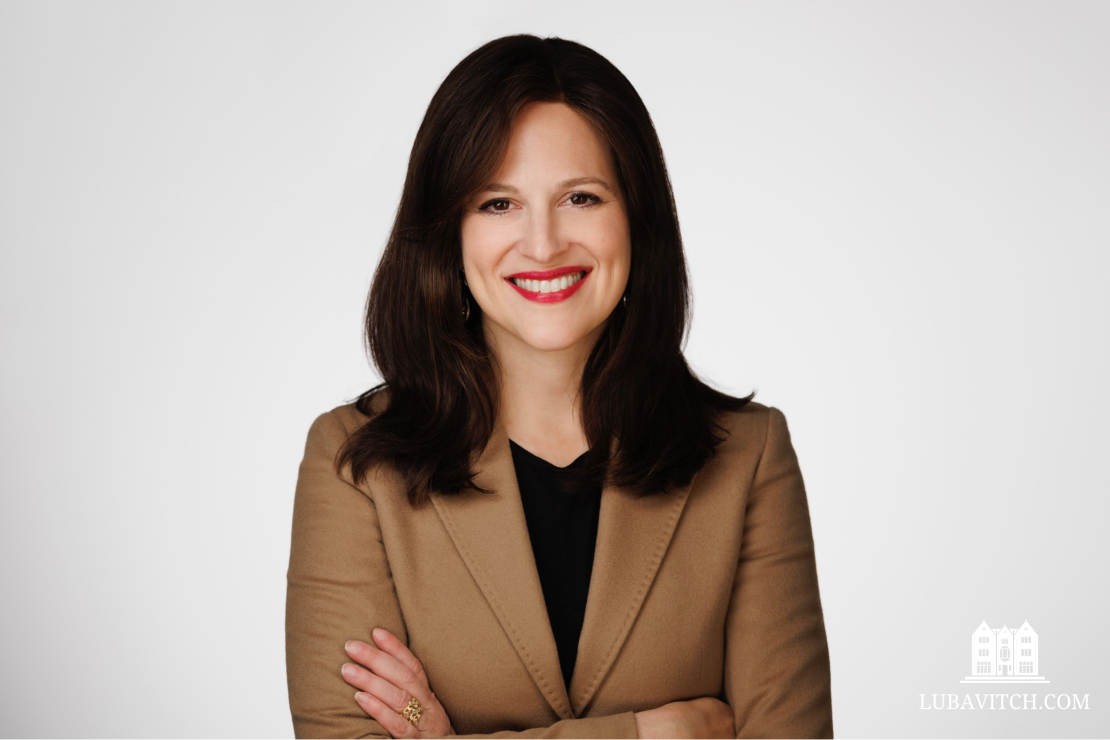


At the National Security Agency, Anne Neuberger directed a force of 19,000 civilian and military personnel charged with countering threats ranging from ISIS to Russian interference in US elections. Later, as deputy national security advisor to President Joe Biden, she became the administration’s most visible voice on cybersecurity. Yet, for most of her career, Neuberger kept her personal story—and the values that animated it—quietly in the background.
Now retired from government, Neuberger sat down with Lubavitch International to reflect on how her family history informed her commitment to public service, how best to combat rising antisemitism, and how serving the country has deepened her own Jewish identity.
You’ve often spoken about how fragile American liberties are. What stories from the past shaped your own definition of freedom?
My mother’s family was from rural Hungary, an area that is now part of the Czech Republic. In 1944, my grandparents and great-grandparents, along with the majority of the Hungarian Jewish population, were deported to Auschwitz. My grandmother survived that experience and came to the United States in the late ’40s, where she met and married my grandfather. I’m named for a great-grandmother—Chana—who was murdered in Auschwitz sometime in the spring of ’44.
My father was born in 1948 and spent his childhood under communism in Hungary. That experience never left him. Many years later, he took our family back to Nyíregyháza, the city where he was born. At one point we were walking down the street and he suddenly became agitated, insisting we make an inconvenient detour to avoid passing a particular building. Later my mother told us that was the former location of the Soviet police station. When he was a child, my father’s parents had instilled in him that he should never walk past there; people disappeared into that police station. That he still couldn’t walk past it fifty years later gave us a picture of what life must have been like.
Through all of this, my family never relinquished their Jewish values. After the failed Hungarian Revolution of 1956, my father and his parents fled to Austria. They were placed on a list to come to America, but the flight was scheduled for Saturday. My grandfather, who also lost both his parents in Auschwitz, said, “My parents weren’t murdered so that I should transgress Shabbos.” He gave up his spot and waited months for another flight. Ultimately they arrived in America in October of 1957, on Hoshanah Rabba. Every year until today my father takes a moment on the holiday to say thank you—thank you that America welcomed our family when they arrived, desperate to build new lives.
How did these experiences play into your decision to pursue public service?
I appreciate the way safety is core to every society. Without security, people live in fear, as Jews have experienced in so many cases from York to Kishinev. But I also appreciate the freedom to be different, because we’ve lived a terrible history when those who are different are often persecuted.
When you look at the history of the Jewish community in America, there has been an evolution. Not long ago I spent Shabbat with my son in Savannah, Georgia. Colonial Savannah did not allow Jews to settle there. But in 1733, they had an epidemic that killed their only doctor. It was only the timely arrival of a Jewish Portuguese surgeon that convinced them to change the law. That was how Savannah became one of the first Jewish communities in America.
The freedoms in the Constitution and Bill of Rights weren’t natural; they were fought for. And that tension—you’re free to be whoever you want to be, but there are limits, because the government is going to ensure that your freedom doesn’t impinge on somebody else’s—that was what drew me to public service. I don’t think it’s a surprise that I was attracted to defense and intelligence. I came from a background that appreciated security—and the discipline of being part of something larger than yourself.
You’ve described your life as “bridging two worlds.” What did that look like in practice?
Aside from my direct supervisors, most people had no idea that I observed Shabbat and Jewish holidays. And, as I became more senior, I always had a deputy who would handle things that came up if I wasn’t available. But, over time, I realized that I had more to share.
When we lived in Washington, D.C., my husband and I began inviting ambassadors and colleagues from the White House for Shabbat dinner. Many of them had Jewish friends, but this was the first time they were encountering Judaism. We found that people loved the experience of Shabbat—three or four hours without distractions, a substantive conversation about values drawing on the weekly Torah reading. I saw how much the wisdom resonated with people, whatever their backgrounds.
Especially today, when antisemitism is rising, I feel an obligation every time I interact with people also to educate. Chabad is a beautiful example of this. Wherever I’ve traveled around the world—Istanbul, Oslo, Singapore, Saigon—I’ve witnessed firsthand Chabad’s love for every Jew and the commitment to bring light wherever people are. It’s deeply inspiring.
Your work in cybersecurity exposes you to many ethical dilemmas, particularly in the realm of artificial intelligence. How does Judaism inform your approach to these problems? Do you believe AI is moving us toward a more perfect world?
Judaism provides an important model for dealing with issues like AI, where nothing is black and white. The Torah doesn’t say avoid all alcohol; it says use it for purposes of holiness. It doesn’t say avoid all intimacy between the sexes; it says do it in the context of a marriage, with additional laws related to that.
AI has tremendous potential. My husband and I support a nonprofit that does voice banking for people with multiple sclerosis and ALS, so that when they eventually lose the ability to speak, they’re still able to access their voice and use it to communicate. On the other hand AI brings real risks as well.
We need a framework to help us glean the good from AI and manage the risks, which is very much a Jewish concept. I spend a lot of my time thinking about how that applies in the context of national security, including cyber threats.
Antisemitism is rising around the world. Your experience gives you unique insight into both its physical and its digital manifestations. What do you believe is the best way to combat it?
First I have to say that in twenty years working in government, I never experienced antisemitism directly.
On a global scale, we definitely see a very concerning rise in antisemitism. In some cases people are combining pro-Palestinian and antisemitic rhetoric and justifying it as free speech. But there’s a difference between diverse views and bullying and intimidation. Right now there’s one community whose schools have armed guards, whose synagogues have physical barriers in front to prevent attacks, and that’s the Jewish community. In a democracy, minorities need to feel safe, and many Jews today do not.
Antisemitism online, whether originating in bad actors manipulating platforms like Wikipedia, or large language models that draw on biased sources, is a real and growing threat. I think that’s where the Jewish community, in a very reasoned and thoughtful way, needs to present hard data and make the case that these platforms need to be fair and shouldn’t be manipulated by malicious users.
My personal style in this area is to speak quietly and bring facts to the table.
Rabbi Jonathan Sacks wrote that “freedom is a moral achievement, and without a constant effort of education, it atrophies and must be fought for again.” At this moment in American history it feels as though we are having that fight again. What role do you see for Jews and Judaism in that effort?
As Jews, we have a responsibility to engage with the societies we live in. The prophet Jeremiah tells the Babylonian Jews, “Seek the peace of the city where I have caused you to be carried away captive, and pray to the L-rd for it; for in its peace you shall have peace.”
For much of our history, Jews faced so much persecution and oppression that they had little opportunity to follow this advice. Even when they did, they were frequently forced to choose between their people and their country. Don Yitzchak Abarbanel, for example, was a very powerful man, the finance minister to King Ferdinand. And yet, when he was forced to choose between conversion or expulsion, he led his community out of Spain.
Fortunately, Jews in America today don’t have to make that painful choice. Personally, I never found my role as a public servant to be in tension with my identity. On the contrary, they reinforced one another.
The moral guidelines of the Torah—leave a corner of your field for the poor; love the stranger, because you were once a stranger—have a lot to contribute to our national conversation. For me, the most important values are responsibility and hakarat hatov, gratitude for the freedoms this country has given us.
We were preparing to celebrate the first night of Chanukah this year when news broke about the massacre on Bondi Beach in Australia. That evening, I drove into Washington for the menorah lighting on the White House lawn. Standing there in the freezing cold, I felt I was showing up to support not only the work of Chabad around the world, but the difficult, unfinished project of building American freedom and Jewish life, side by side.
This article appears in the Spring-Summer 2026 issue of Lubavitch International, to subscribe to the magazine, click here.
 Related Articles
Be the first to write a comment.